Stop Memorising Reactions! Understand These 7 Organic Mechanisms Instead 🧪
Organic chemistry is often considered one of the most challenging subjects because many students try to memorise reactions without understanding why they happen. In reality, every reaction follows a logical sequence of electron movement, bond breaking, bond formation, and intermediate stability.
In this guide, we will walk through seven high-yield organic reaction mechanisms commonly tested in university chemistry courses. Rather than simply presenting the products, each mechanism is explained step by step, highlighting the role of reagents, reaction conditions, intermediates, stereochemistry, and reaction selectivity. By understanding the underlying logic behind each transformation, you'll be able to predict reaction outcomes more confidently instead of relying on memorisation alone.
Whether you're preparing for exams or building a stronger foundation in organic chemistry, this guide will help you connect reaction conditions with mechanistic reasoning and develop a deeper understanding of how organic reactions really work.
1. Synthesis of Methyl Phenyl Ketone via Weinreb Amides and Methyl Grignard Reagents
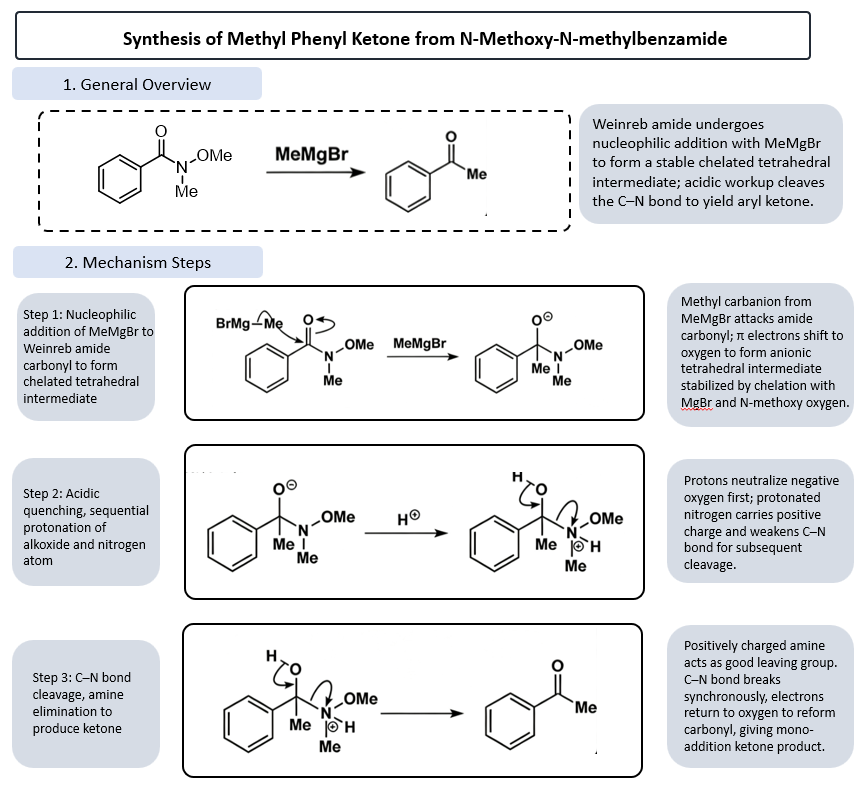
N-Methoxy-N-methylbenzamide (Weinreb amide substrate) undergoes nucleophilic addition with methylmagnesium bromide (MeMgBr). Stable chelated tetrahedral intermediates form; acidic quenching cleaves the C–N bond to exclusively produce mono-addition methyl phenyl ketone with no tertiary alcohol byproducts.
Reaction logic: Methyl carbanions from MeMgBr attack the amide carbonyl to form oxygen-magnesium chelated tetrahedral intermediates that lock the carbonyl group. Protonation under acidic conditions weakens the C–N bond, triggering synchronous cleavage and elimination of amine fragments to reform carbonyl ketones without secondary addition.
- Unique chelating structure of Weinreb amides prevents secondary addition to intermediates
Ordinary esters and amides undergo a second equivalent of Grignard addition to form tertiary alcohols. The methoxy oxygen on the nitrogen of Weinreb amides coordinates with the Grignard MgBr moiety to form stable cyclic tetrahedral chelated intermediates, shielding the carbonyl group from attack by a second Grignard molecule.
Fun illustration note: Chelated intermediate: "Magnesium ions lock the oxygen atom, blocking a second Grignard reagent and halting the reaction at the ketone precursor stage!" Ordinary ester: "No chelation occurs, two equivalents of Grignard directly produce tertiary alcohols."
- Nucleophilic attack of MeMgBr methyl carbanions on amide carbonyls generates chelated tetrahedral intermediates
The methyl carbanion of the Grignard reagent attacks the electron-deficient amide carbonyl carbon. Carbonyl π-electrons shift to oxygen atoms, forming oxygen anions that create dual coordination chelation with MgBr and the N-methoxy oxygen. The intermediates are stable and isolable at ambient temperature.
- Acidic quenching and protonation drastically weaken the C–N bond
Water and acid supply protons to neutralize negative charge on oxygen anions first. Nitrogen atoms are simultaneously protonated to carry positive charge, drastically reducing C–N bond dissociation energy and creating a thermodynamic driving force for bond cleavage.
- Synchronous C–N bond cleavage and electron backshift reconstruct carbonyl groups to form ketones
Positively charged N-methoxy-N-methylamine acts as an excellent leaving group, triggering full C–N bond cleavage. Electron density shifts back from nitrogen to oxygen to reconstruct stable carbonyl groups, producing exclusively mono-addition aromatic ketones with no tertiary alcohol impurities.
Mnemonic:
Grignard reagents add to Weinreb amides to form chelated intermediates that lock carbonyl groups; acid-mediated bond cleavage eliminates amine fragments to produce exclusive mono-addition aromatic ketones.
2. Benzylacetylene Anion as a Nucleophilic Alkynyl Reagent: Reactions with Multiple tert-Butylcyclohexane Substrates
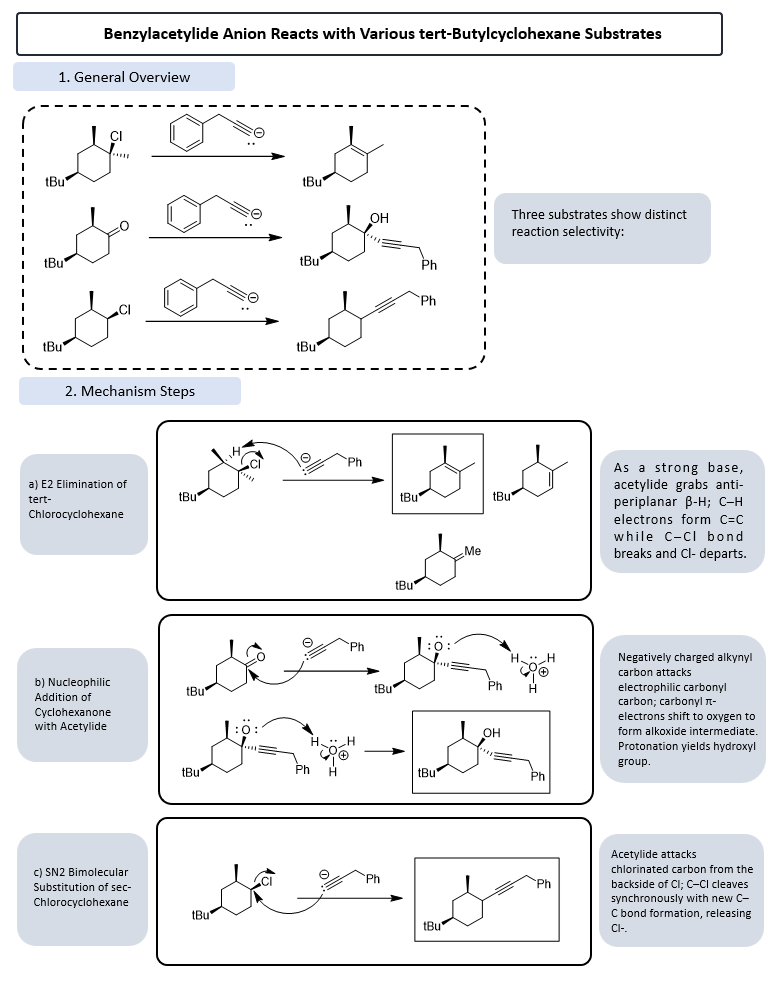
Three types of cyclohexane substrates undergo distinct reactions with benzylacetylene anions: tert-chlorocyclohexane undergoes E2 elimination, cyclohexanone undergoes carbonyl nucleophilic addition, and sec-chlorocyclohexane undergoes bimolecular SN2 nucleophilic substitution. The three substrates exhibit fully differentiated reaction selectivity.
Reaction logic: Sterically hindered tert-chloroalkanes favor E2 elimination as the strongly basic alkynyl anion abstracts β-hydrogen; electron-deficient ketone carbonyls undergo nucleophilic attack by alkynyl anions; less hindered secondary chloroalkanes undergo SN2 substitution via backside attack of alkynyl anions opposite the chlorine leaving group.
- Benzylacetylene anions possess dual strong basicity and nucleophilicity
The negative charge of alkynyl anions concentrates on sp-hybridized carbon, conferring strong basicity. The electron-rich carbanion also delivers potent nucleophilicity. The final reaction pathway is entirely determined by substrate structure, steric hindrance, and functional groups.
The three substrates independently follow three pathways: E2 elimination, carbonyl nucleophilic addition, and bimolecular SN2 substitution.
- tert-Chlorocyclohexane: Severe steric hindrance favors E2 elimination
tert-Chlorocyclohexane exhibits extreme steric bulk around the tertiary carbon. The alkynyl anion cannot approach the saturated carbon from the backside of the chlorine atom. Instead, it acts as a strong base to abstract anti-periplanar β-H adjacent to chlorine, cleaving the C–Cl bond synchronously via E2 elimination to form cycloalkene.
Fun illustration note: Tertiary carbon: "Steric bulk blocks backside attack, so the reaction proceeds via hydrogen abstraction and elimination!" Alkynyl anion: "Steric hindrance prevents substitution; strong basicity drives double bond formation."
- Cyclohexanone substrates: Carbonyl groups undergo preferential nucleophilic addition
Electron-deficient carbonyl carbons represent the optimal electrophilic site in the system. The carbanion of the alkynyl reagent attacks the carbonyl carbon, shifting C=O π-electrons to oxygen to form an oxygen-anion addition intermediate. Upon acid workup, the oxygen anion captures a proton to generate an alkynyl-substituted tertiary alcohol; no elimination or substitution occurs.
- sec-Chlorocyclohexane: Moderate steric hindrance enables backside SN2 nucleophilic substitution
Secondary carbons have moderate steric hindrance, allowing the alkynyl anion to attack the chlorine-bearing carbon from the backside of the leaving group. The C–Cl bond cleaves synchronously as a new C–C alkynyl bond forms, completing concerted SN2 substitution with inversion of stereochemistry at the central carbon, and no alkene byproducts form.
Mnemonic:
Tertiary chloroalkanes follow E2; ketone carbonyls undergo addition; secondary chloroalkanes undergo SN2, alkynyl groups replace chlorine via backside attack.
3. Elimination of Haloalkanes to Alkenes via E2 and E1 Mechanisms under Different Basic Conditions
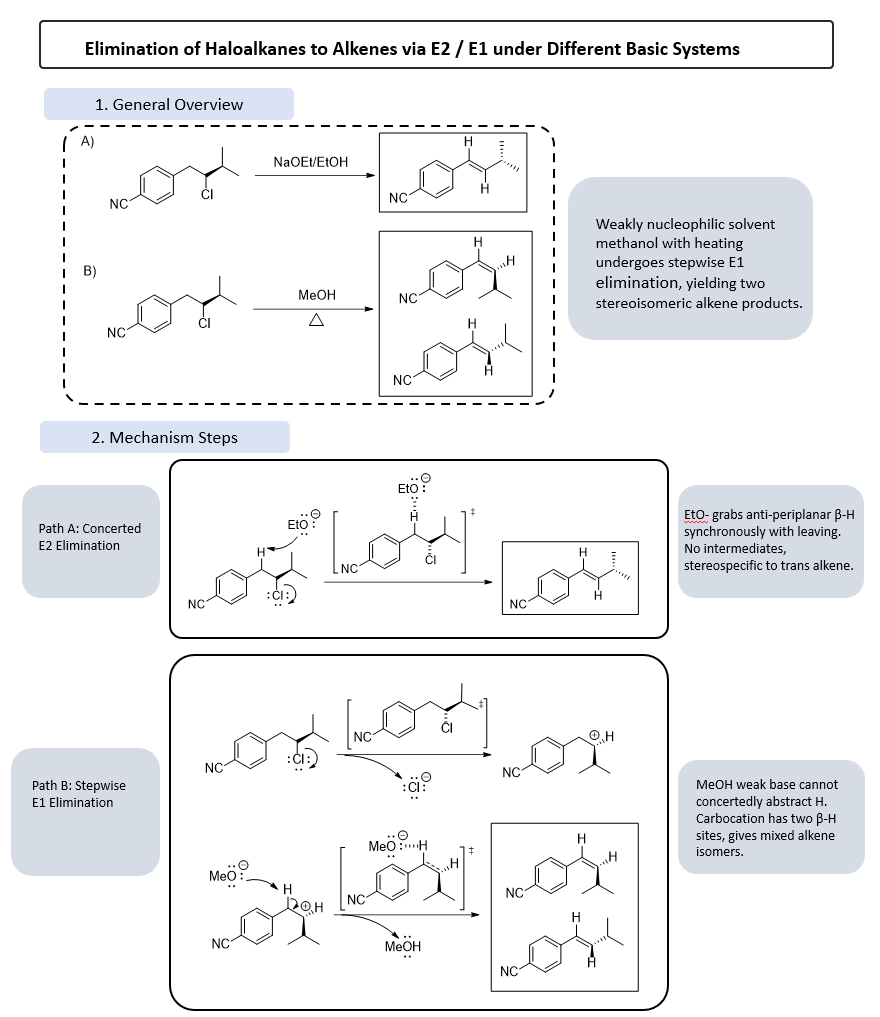
Chloro-substituted alkyl aromatics undergo elimination through two distinct pathways. At low temperature with strong base sodium ethoxide, the reaction proceeds via concerted E2 elimination with a single transition state to form a single alkene isomer. When heated in weakly nucleophilic methanol, stepwise E1 elimination occurs; the carbocation intermediate allows deprotonation of two types of β-hydrogens, yielding a mixture of stereoisomeric alkenes.
Reaction logic: Strong base abstracts β-hydrogen synchronously; concerted transition state leads to simultaneous cleavage of C–H and C–Cl bonds, producing one unique alkene via E2. Weak solvent with heating first breaks C–Cl to form a carbocation; two sets of β-hydrogens can be removed separately, generating mixed alkenes via stepwise E1.
- Distinct active species in the two reaction systems
Strong base system: Sodium ethoxide fully dissociates to produce ethoxide anions, strong nucleophiles capable of abstracting hydrogens; no free solvent molecules participate in carbon skeleton cleavage.
Weak solvent heating system: Methanol acts as a weak base and weak nucleophile with no strongly nucleophilic anions. Heat raises molecular energy to spontaneously cleave the C–Cl bond.
The strength of the base and reaction temperature directly determine whether the reaction follows the concerted E2 or stepwise E1 mechanism.
- E2 pathway: Synchronous deprotonation by ethoxide through a single concerted transition state
As a strong base, ethoxide anion attacks the β-hydrogen anti-periplanar to the chlorine atom. Electron density from the C–H bond shifts between the two carbon atoms, while all electrons from the C–Cl bond transfer to the chlorine atom, passing through a five-membered cyclic transition state simultaneously.
No intermediates are generated throughout the process. The hydrogen fully detaches, the carbon-carbon double bond forms synchronously, and chlorine departs the molecule as a chloride ion.
Fun illustration note: β-hydrogen: "I lie anti-periplanar to chlorine; the strong base grabs me all at once!" Chlorine: "Bonds break simultaneously, I leave immediately, and an alkene forms in one step."
- E1 pathway: Thermal dissociation to carbocation, two β-hydrogens produce two elimination products
Methanol is too weakly basic to abstract hydrogen synchronously. Heating provides energy to break the C–Cl bond first; chloride leaves to form a secondary carbocation intermediate.
The carbocation bears two chemically distinct β-hydrogens on adjacent carbons. Methanol can randomly abstract either β-H. The two elimination pathways have similar activation energies, generating a mixture of stereoisomeric alkenes.
Carbocation intermediates are prone to rearrangement via alkyl shifts, altering the carbon skeleton.
- Dramatic difference in stereospecificity of products
The concerted E2 mechanism is stereospecific: only β-hydrogens anti-periplanar to chlorine can be eliminated, yielding solely the thermodynamically stable trans-alkene.
The stepwise E1 mechanism has no stereochemical constraints. β-hydrogens on both sides of the planar carbocation can be removed, resulting in a mixture of alkene products.
Mnemonic:
Strong base + low temperature follows E2, one transition state yields one alkene; weak base + heat proceeds stepwise E1, carbocation creates dual pathways.
4. Horner-Wadsworth-Emmons Olefination of Phosphonates with Acetone
Sodium hydride serves as a strong base to generate phosphonate carbanions, which attack acetone carbonyl groups. A four-membered cyclic transition state mediates concerted elimination of phosphate esters to form α,β-unsaturated alkenes, a classic mild method for synthesizing trans-enones and enoates.
Reaction logic: NaH deprotonates the α-position of phosphonates to generate carbanions; carbanions attack carbonyl groups to form oxygen-anion addition intermediates; intramolecular attack of the oxygen anion on phosphorus triggers four-membered cyclic concerted elimination of phosphate esters to yield thermodynamically stable alkenes.
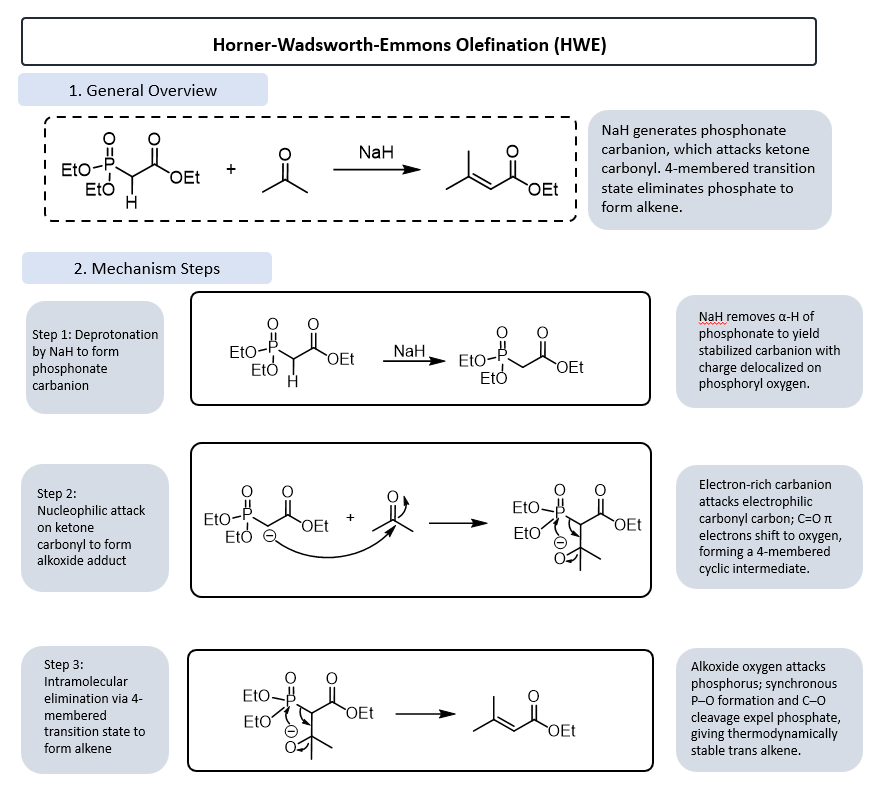
- The core function of NaH is deprotonating the acidic α-hydrogen of phosphonates
α-Hydrogens of phosphonates exhibit enhanced acidity due to electron-withdrawing effects from adjacent phosphoryl and ester groups. Sodium hydride releases hydride anions to abstract α-protons and form stabilized carbanions, with negative charge delocalized via the phosphoryl oxygen atoms.
Pure acetone and phosphonates show no reactivity; generation of carbanions via strong base is required to initiate olefination.
- Carbanions attack ketone carbonyls to form four-membered cyclic addition intermediates
Electron-rich phosphonate carbanions attack the electron-deficient carbonyl carbon of acetone. C=O π-electrons shift to oxygen, generating negatively charged oxygen atoms and forming four-membered cyclic intermediates with a P–O–C–C backbone, establishing the framework for subsequent intramolecular elimination.
Fun illustration note: Phosphonate carbanion: "Delocalized negative charge stabilizes me; I target carbonyl carbons to build four-membered rings!" Carbonyl group: "π-electrons shift to oxygen, awaiting intramolecular elimination."
- Intramolecular attack of oxygen anion on phosphorus drives four-membered cyclic concerted elimination
The negatively charged oxygen atom in the intermediate attacks the central phosphorus atom, triggering synchronous electron rearrangement within the four-membered cyclic transition state. A new P–O bond forms as the C–O bond cleaves simultaneously, expelling phosphate ester small molecules and generating thermodynamically stable trans α,β-unsaturated enoates.
- Exclusive stereoselectivity of HWE reactions favoring trans alkenes
The phosphorus-oxygen double bond possesses extremely high bond energy, providing a strong thermodynamic driving force for intramolecular elimination. The reaction equilibrium heavily favors thermodynamically stable trans alkenes, with negligible cis-alkene formation, distinguishing it from Wittig reactions that produce stereoisomer mixtures.
Mnemonic:
NaH deprotonates phosphonates to generate carbanions; carbonyl attack forms four-membered rings; intramolecular phosphate elimination exclusively yields trans unsaturated alkenes.
5. Mechanism of Free-Radical Bromination of Indane Derivatives under UV Irradiation
UV light provides energy to homolytically cleave the σ-bond of bromine molecules to generate bromine radicals. Two radical chain propagation steps selectively abstract tertiary hydrogens to form tertiary carbon radicals, which combine with elemental bromine to form the major brominated product.
Reaction logic: Light homolyzes Br₂ to initiate radical chain reactions; bromine radicals abstract tertiary hydrogens to release HBr and form stable tertiary carbon radicals; tertiary radicals attack Br₂ to form brominated products and regenerate bromine radicals, sustaining the cyclic chain reaction.
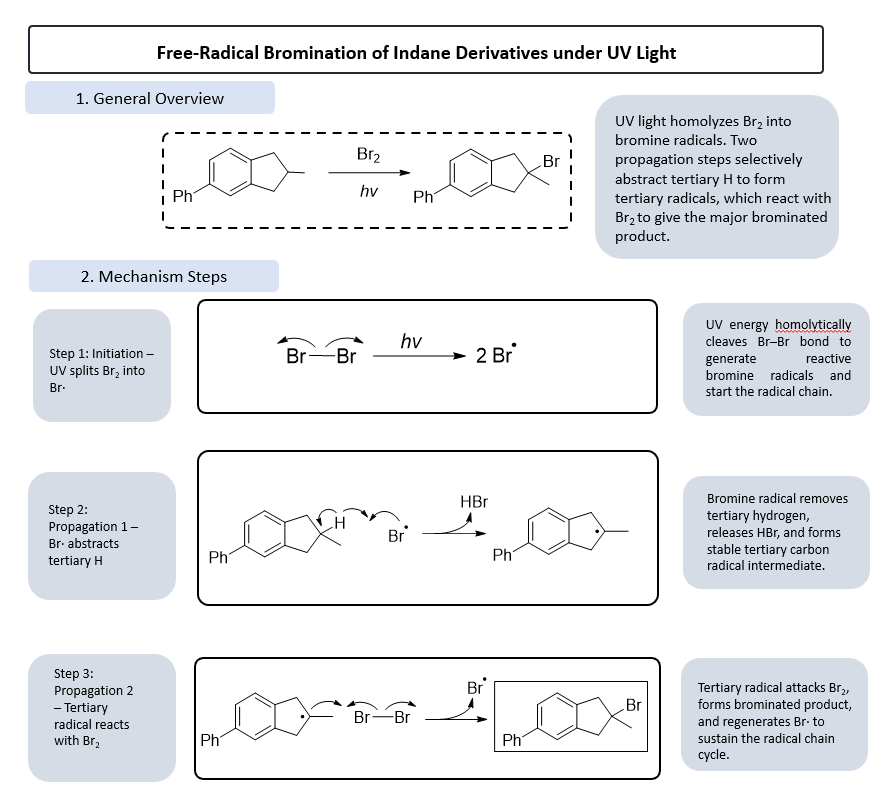
- Photogenerated bromine radicals initiate the reaction
Br₂ molecules are stable at room temperature and cannot spontaneously abstract C–H hydrogens. UV irradiation supplies energy to break the Br–Br covalent bond, splitting the bonding electron pair equally between two bromine atoms to form highly reactive bromine radicals that initiate hydrogen-abstraction chain reactions.
Bromine water without UV light barely undergoes alkane bromination; irradiation is an essential condition for radical reactions.
- Bromine radicals selectively abstract stable tertiary hydrogens
Bromine radicals are highly selective. They preferentially cleave weaker tertiary C–H bonds to release one molecule of HBr, leaving the electron pair on the tertiary carbon to form thermodynamically stable tertiary carbon radical intermediates.
Benzylic and tertiary radicals gain stability via conjugation and hyperconjugation, so secondary and primary hydrogens are barely abstracted, granting exclusive regioselectivity.
Fun illustration note: Tertiary hydrogen: "My C–H bond has low bond dissociation energy; bromine radicals target me exclusively!" Bromine radical: "Hydrogen abstraction creates stable carbon radicals and launches the chain cycle."
- Chain propagation regenerates bromine radicals for continuous cycling
The tertiary carbon radical attacks elemental Br₂ in the system; a bromine atom bonds to the tertiary carbon to form the final brominated product, while a new bromine radical is released to participate in further hydrogen abstraction and sustain the radical chain reaction.
Minimal UV light generates trace bromine radicals capable of converting large quantities of substrate; radicals are continuously regenerated in the cycle.
- Minor side reaction: Chain termination
Radical chain termination occurs when two bromine radicals, two carbon radicals, or one bromine radical and one carbon radical combine pairwise, consuming radicals and halting the chain cycle. Continuous UV irradiation is required to replenish consumed radicals.
Mnemonic:
Light splits bromine to make radicals; tertiary hydrogen extraction releases HBr; tertiary carbons capture bromine and regenerate radicals, selective bromination targets tertiary sites.
6. Mechanism of Concerted E2 Elimination of Bromocycloalkanes with Sodium Methoxide
The cis-adjacent β-hydrogen and bromine atom adopt an anti-periplanar conformation. Methoxide anions derived from sodium methoxide synchronously abstract the β-hydrogen and expel bromide ions via a five-membered cyclic concerted transition state to form alkene products in one step.
Reaction logic: Methoxide anions attack anti-periplanar β-H; C–H electron density shifts toward the carbon-carbon linkage while C–Br cleaves simultaneously. Electron rearrangement within the five-membered transition state synchronously forms a carbon-carbon double bond, methanol, and bromide ions to produce alkene in a single step.
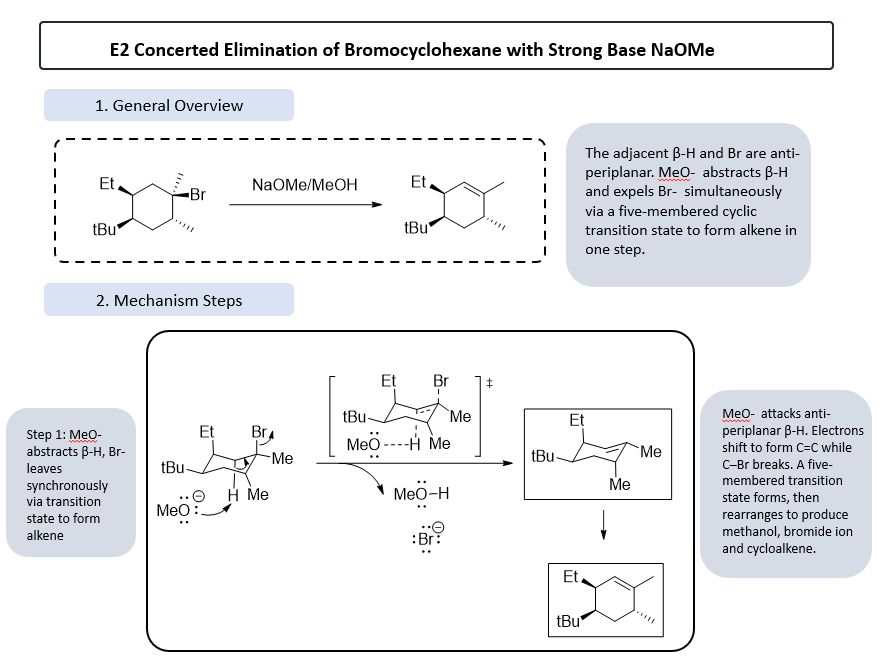
- Strict stereochemical requirement for E2 elimination: β-H and Br must be anti-periplanar
Cyclohexane rings adopt chair conformations. Only when the leaving group Br and adjacent β-hydrogen lie on opposite sides of the ring (anti-periplanar) can orbital overlap occur to form the five-membered cyclic concerted transition state. β-hydrogens in syn-periplanar geometry cannot participate in E2 elimination.
E2 reactions scarcely proceed if no anti-periplanar β-hydrogen exists.
- Synchronous deprotonation and debromination by methoxide through a single transition state
Sodium methoxide dissociates to release strongly basic methoxide anions, which attack anti-periplanar β-H. Electron density from the C–H bond shifts between carbons, and all C–Br bonding electrons transfer to bromine. Electron rearrangement completes simultaneously within the five-membered transition state.
No carbocation or radical intermediates form at any stage; the reaction proceeds in one concerted step without sequential bond dissociation.
Fun illustration note: Methoxide: "I grab hydrogen simultaneously as bromine departs; the five-membered transition state forms a double bond in one step!" Cycloalkyl carbon: "Anti-periplanar geometry is mandatory—misaligned orbitals block the reaction."
- Synchronous formation of methanol and bromide ions yields a single cycloalkene
After electron rearrangement in the transition state, the C–H bond fully breaks to form a carbon-carbon double bond. The abstracted hydrogen combines with methoxide to generate methanol, while bromine carries a full electron pair to depart as bromide ions. Only one single substituted cycloalkene is produced, with no mixed stereoisomers.
- Reactive at low temperature with strong base, no carbon skeleton rearrangement
The concerted E2 mechanism contains no carbocation intermediates, so no 1,2-hydride or alkyl shifts occur. The original cycloalkane carbon skeleton remains fully intact with no rearrangement byproducts.
Mnemonic:
E2 elimination demands anti-periplanar geometry; strong base abstracts hydrogen and expels bromide synchronously; five-membered transition state completes the reaction in one step to form cycloalkenes directly.
7. Oxidation of N,N-Dimethylcyclohexylamine with mCPBA Followed by Thermal Elimination to Cycloalkene
m-Chloroperoxybenzoic acid (mCPBA) acts as an oxidant to convert tertiary amines to amine oxides. Upon heating, amine oxides undergo intramolecular Ei concerted elimination via a five-membered cyclic transition state, simultaneously eliminating N,N-dimethylhydroxylamine to form substituted cycloalkenes.
Reaction logic: The peroxy bond of mCPBA transfers an oxygen atom to the tertiary amine nitrogen to generate an amine oxide; heating triggers a five-membered cyclic transition state, synchronously removing β-H and cleaving the C–N bond for intramolecular concerted elimination to yield alkenes.
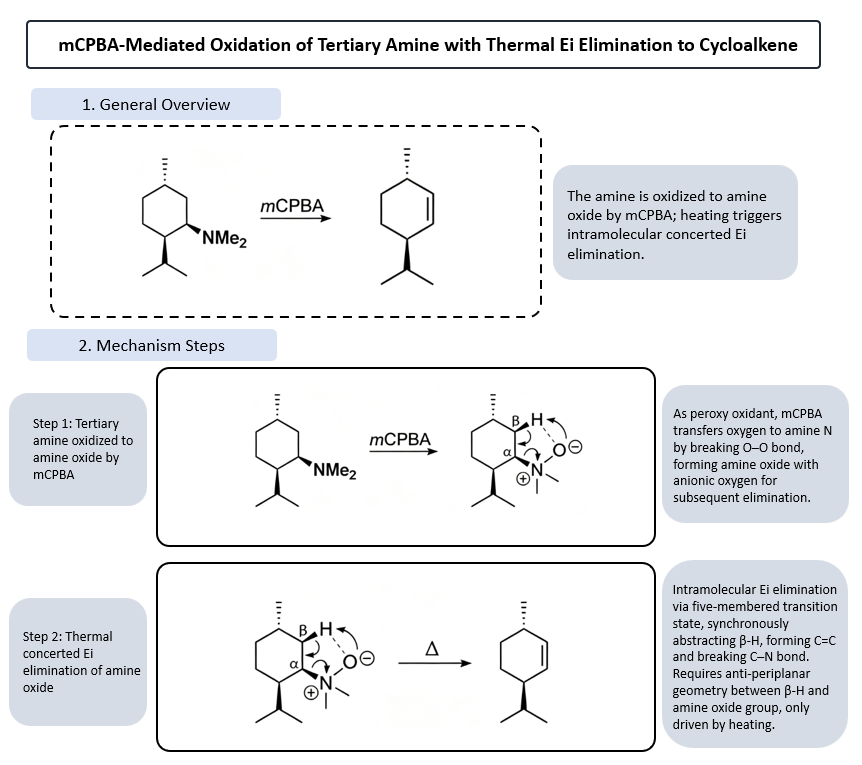
- mCPBA delivers active oxygen to oxidize tertiary amines into amine oxides
mCPBA contains weak peroxy O–O bonds. Electron-rich tertiary amine nitrogen attacks the peroxy linkage, breaking the O–O bond and transferring an oxygen atom to nitrogen to form amine oxides, the mandatory intermediate for Ei elimination.
Oxidation at low temperature and thermal elimination are separable by reaction conditions: only oxidation proceeds at low temperature, while elimination requires heating.
- Ei elimination is purely intramolecular and concerted, requiring no external acid or base
Unlike E1/E2 which rely on external acids or bases, Ei elimination depends entirely on the native anionic oxygen site of the amine oxide. A five-membered cyclic transition state forms intramolecularly to synchronously remove β-hydrogen and cleave the C–N bond.
Only heating is required to supply activation energy for the transition state; no external nucleophiles or strong bases participate.
Fun illustration note: Amine oxide: "No external base required—my native anionic oxygen captures adjacent hydrogen for one-step intramolecular elimination." Cycloalkyl group: "β-hydrogens must adopt anti-periplanar geometry relative to the amine oxide group for reaction to proceed."
- Five-membered cyclic transition state synchronously removes hydrogen and cleaves C–N bonds
Upon heating, the anionic oxygen of the amine oxide abstracts anti-periplanar β-H. Electron density rearranges synchronously to form a carbon-carbon double bond, and the C–N bond cleaves simultaneously to produce substituted cycloalkene and the small-molecule byproduct N,N-dimethylhydroxylamine.
- Strict stereochemical constraints: only anti-periplanar β-hydrogens undergo elimination
The amine oxide group and β-hydrogen must lie anti-periplanar on opposite sides of the cycloalkane ring. Syn-periplanar hydrogens cannot participate in the intramolecular transition state, fixing the regio- and stereochemistry of products with no mixed alkene isomers.
Mnemonic:
mCPBA oxidizes amines to amine oxides; heating drives five-membered cyclic Ei elimination; synchronous hydrogen removal and C–N cleavage produce alkenes and hydroxylamine byproducts.
The step-by-step structure makes the calculations much easier to review.
I like that the guide explains what each number means, not just the formula.
The common-mistake sections are especially useful for revision.
This is a helpful bridge between mechanism and calculation.
The practice prompts give the guide a nice ending.
I would love to see more worked examples with structures.
The reaction-coordinate section finally made sense to me.
A very useful study post for organic chemistry students.